Enterprise Reinforcement Learning Agents That Learn, Adapt, & Optimize

> |

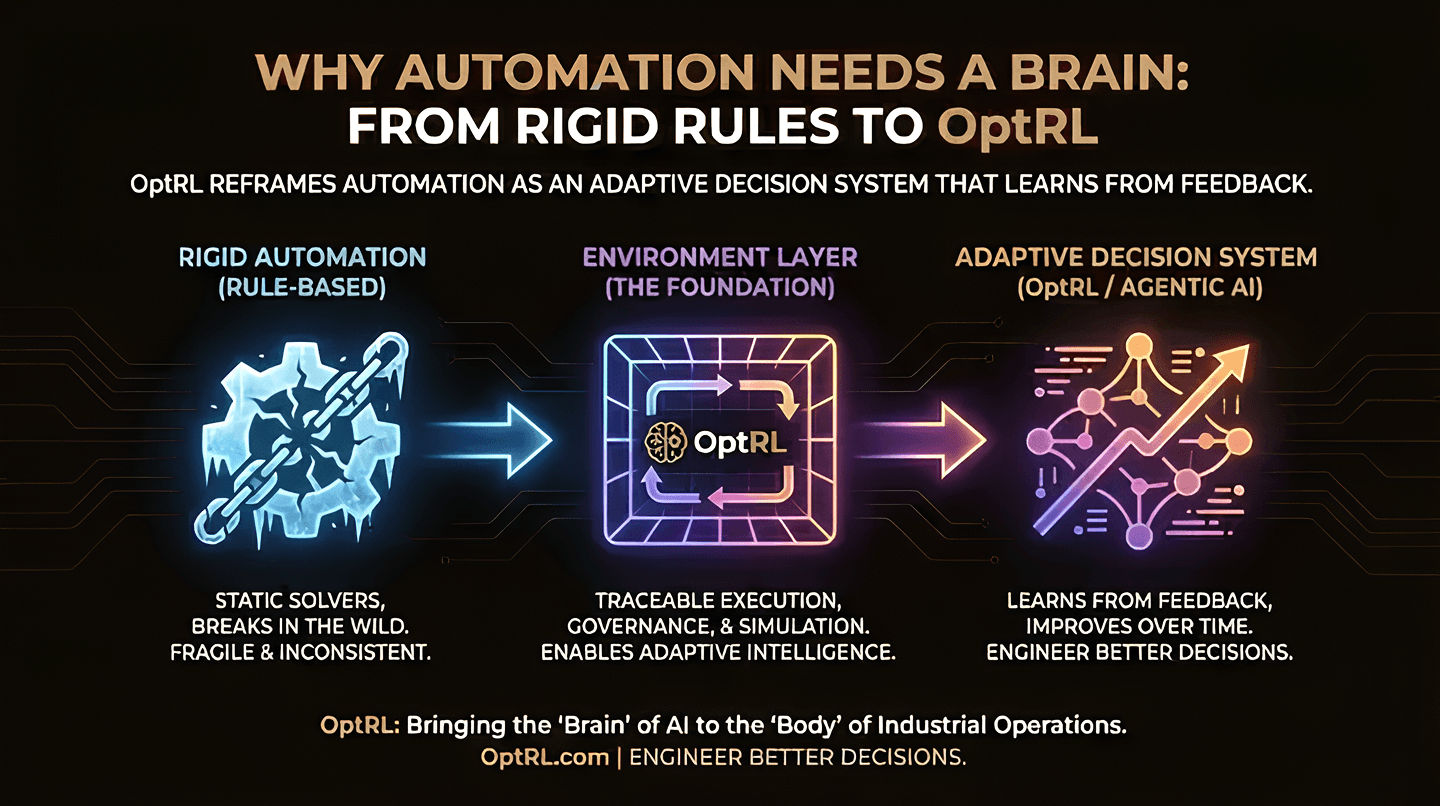
OptRL provides enterprise reinforcement learning consulting and RL-as-a-service to design, deploy, and operate adaptive decision systems that continuously improve pricing, logistics, and operational performance in live environments.

65.6%
RL Market CAGR
10x
Faster Adaptation
24/7
Autonomous Ops

Reinforcement Learning Is Moving from Research to Enterprise Infrastructure

Market data and operational benchmarks confirm that adaptive decision systems are becoming a core enterprise capability.

65.6% CAGR in Reinforcement Learning

Reinforcement learning is one of the fastest-growing AI segments, driven by demand for adaptive decision systems.

Market Growth
Enterprise Adoption Accelerating by 2028

RL-powered decision layers are expected to become embedded in pricing, logistics, and workflow software stacks.

Enterprise Software Expansion
Why Reinforcement Learning Now
StaticAImodels,traditionalfine-tuning,andretrospectiveanalytics
can'tkeeppacewithdynamicmarkets.
OptRLbuildsintelligentautomationsystemsthatexperiment,learn,andcontinuouslyimprovewitheverydecisioncyclekeepingyourenterpriseresponsive,resilient,andaheadofthecompetitionthroughadaptiveAItechnology.

Tailored Learning Environments

Domain-specific simulators let agents explore safely before production.

Actively Learning AI Agents

Policies evolve in real time based on fresh feedback loops.

Simulation-First Experimentation

Stress test strategies, analyze edge cases, and surface emergent behavior at scale.

Adaptive Decision Systems

Evolve from static LLM workflows to continuous-learning pipelines that deliver measurable outcomes.

Services

Enterprise AI & Machine Learning Solutions, Delivered End-to-End

End-to-end enterprise reinforcement learning consulting, RL-as-a-service, simulation environment design, and RLOps infrastructure for production-grade decision systems. Our comprehensive AI consulting services span business strategy, simulation environments, policy engineering, production deployment, MLOps, and governance - designed to transform AI initiatives from proof-of-concept to production-grade business impact with measurable ROI. Each engagement is structured in business terms: who the workflow serves, what metric should improve, and what timeline defines a meaningful first result.

Translate business objectives into RL frameworks and experimentation roadmaps.
Align KPIs with reward design and long-term strategic impact.
Identify automation opportunities and define ROI metrics.
Connect data science and operations into unified adaptive workflows.
Model multi-agent dynamics, rare events, and complex feedback loops.
Accelerate policy robustness via controlled experiments.
Deploy cloud or edge simulators with observability built-in.
Apply bandits, DQN, actor-critic methods, and continual learning.
Shape rewards to reflect constraints and maintain exploration balance.
Benchmark across simulation and production with safety gates.

Translate business objectives into RL frameworks and experimentation roadmaps.

Who it's for

Ops, product, and strategy leaders aligning AI to measurable goals.

Typical outcome

Clear success metrics, prioritized use cases, and a practical rollout plan.

Timeline

Typical first milestone: 1-2 weeks for discovery + KPI framing.

Embed decision layers within CRM, ERP, and workflow systems.

Who it's for

Teams that need AI decisions embedded in existing systems and workflows.

Typical outcome

Operational handoff from pilot to real usage with lower adoption friction.

Timeline

Typical first milestone: API/integration plan and deployment path.

Provide secure policy APIs with runtime guardrails.
Enable low-latency inference, CI/CD retraining, and observability.
Align fully with existing data ecosystems.
Multi-agent workload support at scale.
Automated evaluation, drift correction, versioning, and rollouts.
Continuous retraining based on live feedback signals.
Interpretability reports, fairness audits, and ROI tracking.
Governance dashboards for compliance, ethics, and real-world impact.
Continuous monitoring to reinforce trust and alignment.
Solutions

Built-for-Impact RL Solution Gallery

Each solution ships with embedded measurement, governance, and Agentic Guardrails to jumpstart production impact across growth, operations, and intelligence workloads. These are outcome-focused building blocks for business teams, not just technical demos.

Adaptive Recommendation Engine

Ensemble bandits + hierarchical clustering for in-the-moment personalization.

Increase conversionPersonalize offersReduce manual tuning
Learns from user behavior and context in real time.
Balances exploration, conversion, and trend sensitivity.
Plugs into e-commerce and media systems.

Dynamic Pricing & Demand Optimization

RL-driven real-time pricing adjustments.

Protect marginRespond faster to demandControl pricing risk
Models elasticity, competition, and seasonality.
Continuous contextual experimentation under safety controls.
Tuned for retail, SaaS, and travel.

Operational Workflow Optimizer

Agents that streamline operations by learning from every task.

Cut delaysImprove utilizationReduce manual scheduling
Automates routing, scheduling, and resource allocation.
Predicts delays and rebalances workloads.
Integrates with logistics and ERP systems.

Personalized Engagement Engine

Campaigns that self-tune based on reward signals.

Improve retentionIncrease campaign efficiencyAdapt customer journeys
Optimizes cadence, channel, tone, and sequencing.
Learns across the customer journey.
Connects to CRM and marketing automation stacks.

Resource Allocation & Simulation Suite

Multi-agent simulation for fleets, supply chains, and infrastructure.

Reduce stockouts/downtimeStress-test decisionsPlan for edge cases
Stress tests, rare event modeling, and sensitivity analyses.
Sensor-driven real-time coordination logic.
APIs and dashboards for operations teams.

Decision Intelligence Dashboard

Full transparency into every policy decision.

Make AI decisions auditableTrack ROISupport governance reviews
Reward curves, drift charts, governance metrics.
Built-in explainability and compliance reporting.
Automates oversight with auditable outputs.
RL Frontier Research

Shaping the Next Wave of Adaptive AI & Intelligent Systems

OptRL invests in cutting-edge AI research and machine learning frameworks that push the boundaries of performance, safety, and ethical alignment - ensuring every AI deployment remains benchmarked, transparent, and responsible with built-in guardrails.

RLX Leaderboards

Benchmark agents on exploration, generalization, and safety metrics with transparent scorecards.

Self-Reflective Learning (SRL)

Teach agents to audit their own trajectories, revise strategies, and document reasoning trails.

Meta-Ethical Reward Shaping

Align policies with nuanced cultural and human values via value-sensitive reward engineering.

Safe-RL Protocols

Engineer verifiably robust policies for high-risk domains with formal safeguards.

Why Choose OptRL

Enterprise AI with Agentic Guardrails & Measurable Business Impact

The next generation of enterprise AI and adaptive intelligence requires more than sophisticated algorithms - it needs Agentic Guardrails that ensure safety, ethical alignment, and reliability across the entire AI decision lifecycle. We also keep the process understandable for non-technical stakeholders: what will change, what outcomes to expect, what data is needed, and how progress will be reviewed.

MLOps and AgentOps observability with 45+ prebuilt production monitors.

AI Guardrails that enforce ethical alignment and prevent harmful autonomous actions.

Reward engineering, safety controls, and human-in-the-loop feedback systems for continuous improvement.

Executive dashboards with fairness metrics, model drift detection, and clear ROI tracking.

How We Work

Discovery, pilot, and rollout phases with clear owners and decision checkpoints.

What We Need

Business goals, access to relevant data, and a team contact who knows the workflow.

How Success Is Measured

Pre-agreed metrics such as margin, service level, throughput, or time saved.

What Leadership Sees

Regular updates on impact, risks, model behavior, and next deployment decisions.

About OptRL

Mission & Vision

OptRL bridges the gap between cutting-edge AI research and enterprise machine learning deployment. We align cross-functional teams around adaptive intelligence programs that deliver measurable business results across AI strategy, simulation, production deployment, and ongoing governance.

Mission

Translate reward signals into durable, auditable, high-impact business value.

We align cross-functional teams around adaptive AI programs that deliver measurable KPIs across business strategy, simulation environments, policy deployment, and ongoing governance - from concept to production AI systems.

Vision

Make continuous learning a scalable, managed capability for every enterprise.

Our teams combine AI researchers, machine learning engineers, and MLOps specialists who design transparent, evolving, and regulation-ready intelligent systems. We build autonomous learning pipelines your teams can inherit, understand, and trust - with explainable AI, ethical guardrails, and business value aligned with every decision maker and stakeholder.

Reinforcement Learning Insights & Applied Intelligence

Practical perspectives on enterprise reinforcement learning, simulation design, RLOps infrastructure, and adaptive decision systems.
Frequently Asked Questions

Reinforcement Learning in Enterprise: Common Questions Answered

Enterprise reinforcement learning is a closed-loop machine learning approach where decision policies continuously improve from real-world feedback. Unlike static predictive models, reinforcement learning optimizes long-term business KPIs such as margin, service level, throughput, and efficiency by learning directly from outcomes in dynamic environments.
Traditional machine learning predicts outcomes from labeled historical data. Reinforcement learning learns decision strategies through trial, feedback, and reward signals. Instead of predicting what will happen, reinforcement learning determines what action to take to maximize long-term performance under changing conditions.
Reinforcement learning is especially effective in industries with dynamic decision environments, including retail pricing, logistics and fleet management, supply chain optimization, utilities and grid management, manufacturing workflows, and digital personalization systems where conditions shift frequently.
RL-as-a-service is a managed operating model where reinforcement learning systems are deployed, monitored, retrained, and governed continuously. It includes RLOps infrastructure, observability dashboards, safety guardrails, and performance measurement to ensure reliable production impact without building a full internal RL team.
A typical enterprise reinforcement learning engagement begins with a discovery phase of 1–2 weeks, followed by a pilot lasting 4–8 weeks. Full production deployment timelines vary depending on integration complexity, data readiness, and workflow scale.
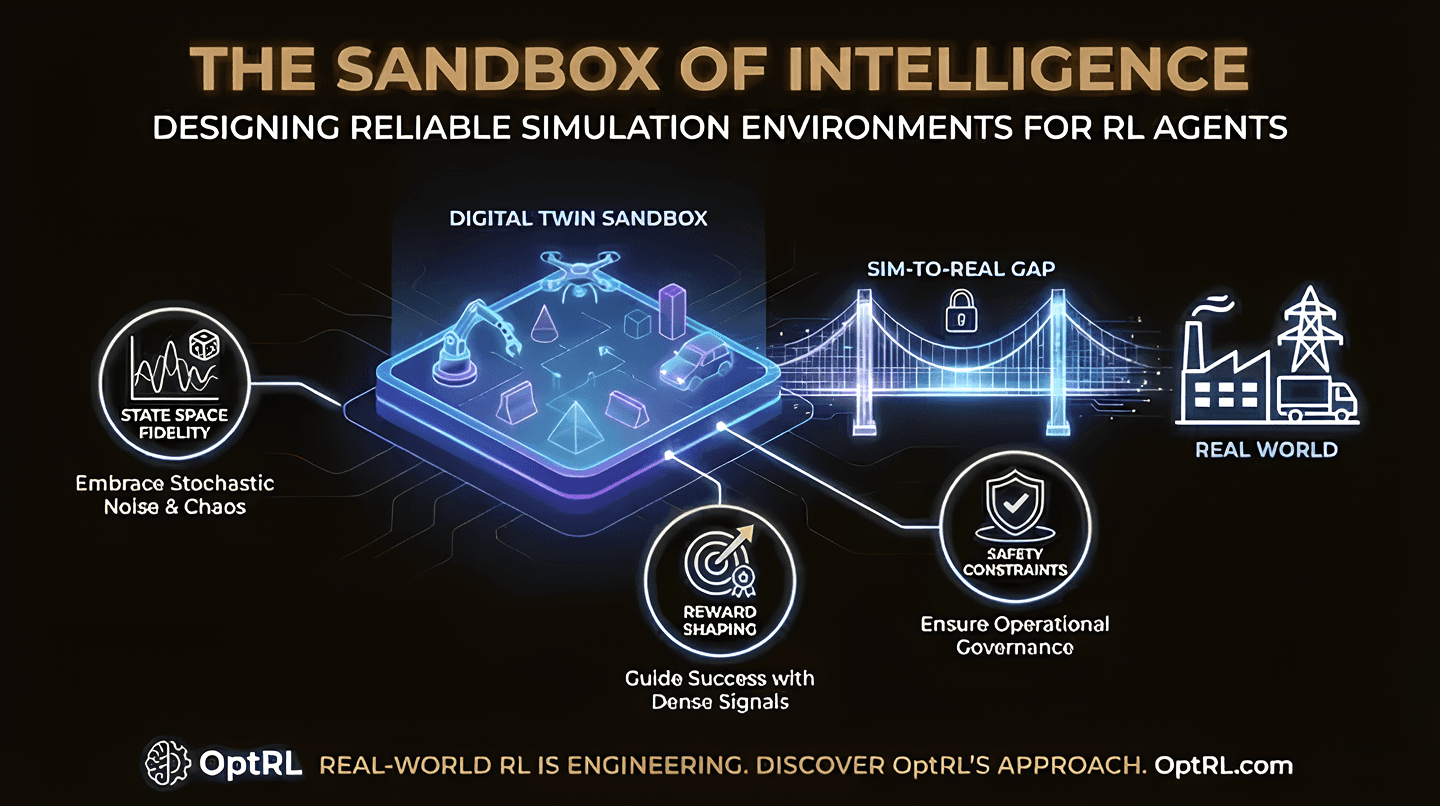
Most reinforcement learning pilots fail at deployment, not modeling. The sim-to-real gap, lack of monitoring infrastructure, insufficient reward design, and missing safety guardrails often prevent successful production rollout. Robust RLOps and governance are critical to closing this gap.
OptRL uses simulation-first experimentation, runtime guardrails, reward alignment frameworks, drift detection, human-in-the-loop controls, and observability dashboards. These mechanisms ensure that adaptive policies remain stable, auditable, and aligned with business constraints and compliance requirements.
Reinforcement learning performs best where decisions must adapt continuously. Common use cases include dynamic pricing, demand forecasting optimization, routing and scheduling, inventory allocation, personalized engagement systems, and resource coordination across complex operational environments.
Performance is measured against predefined KPIs such as revenue uplift, cost reduction, service level improvement, waste reduction, throughput gains, or conversion increases. Reinforcement learning systems are evaluated continuously using reward curves, drift metrics, and operational dashboards.
Yes, with proper governance. Reinforcement learning can be deployed in regulated industries when supported by safety guardrails, explainability layers, compliance reporting, and human oversight. Structured reward engineering and policy constraints ensure responsible and auditable decision behavior.